
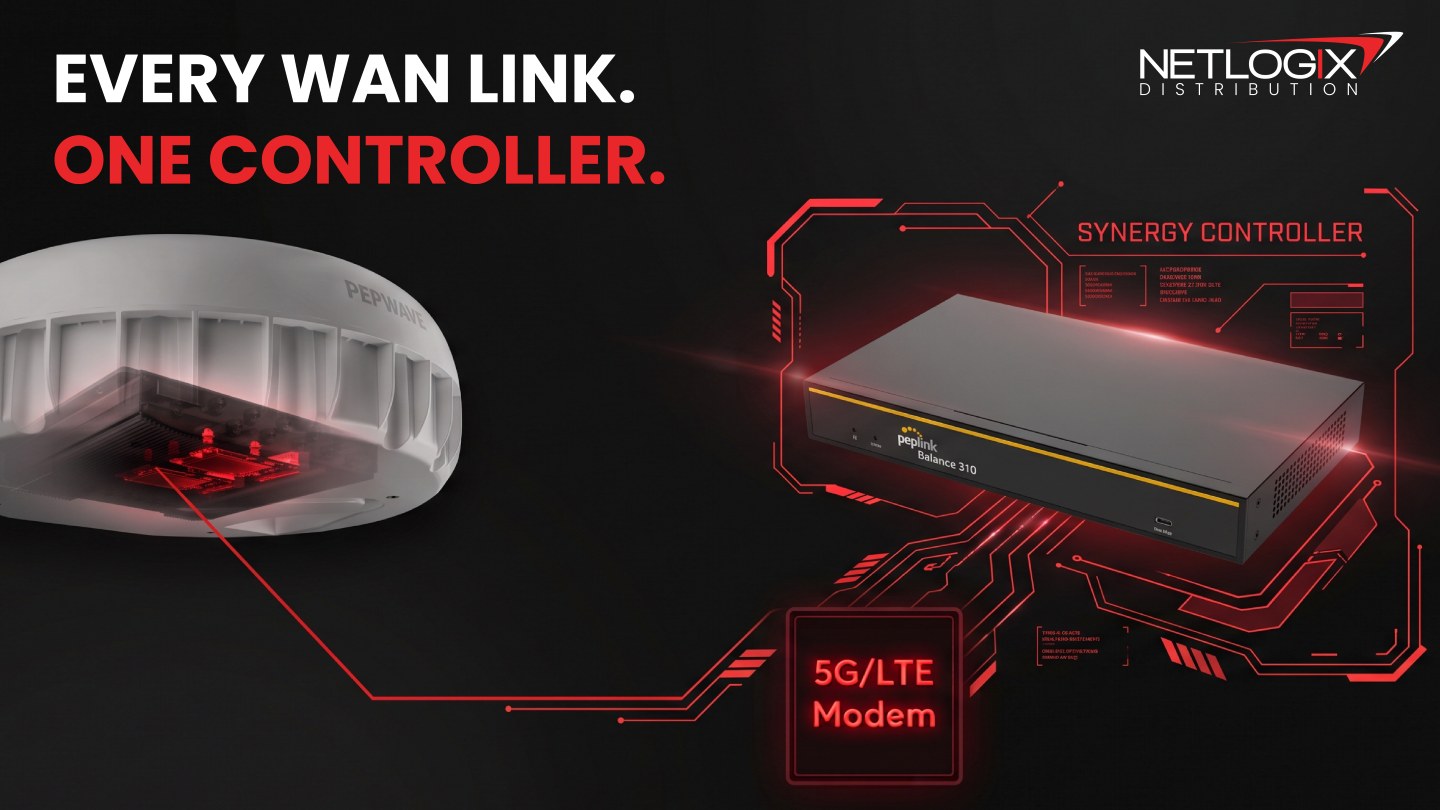
Adding another internet link should not mean adding another configuration to manage. Peplink Synergy Mode lets you aggregate the WAN links of multiple Peplink devices behind a single controller, so every Ethernet, Wi-Fi, cellular and USB connection appears as a native interface on one router.
That single change removes a problem most channel partners know well. Resilience is normally built one link at a time: a fibre line first, then a cellular service as backup, then a second carrier, and increasingly a satellite path for the sites where nothing else reaches. Each decision is correct on its own. The cost accumulates behind them, in the number of devices an engineer has to hold in their head.
Why WAN Sprawl Costs More Than It Saves
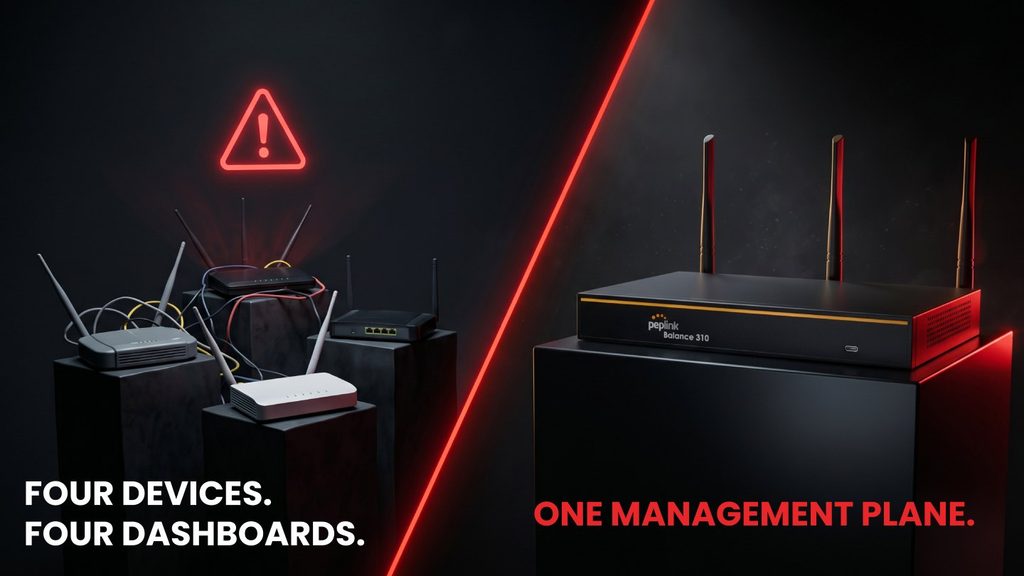
A site with four connectivity paths on four separate devices is not four times as resilient. It is four times as much to configure, patch, monitor and document. Across South Africa and the wider region, that overhead lands against load shedding, unstable fibre, cable theft and fluctuating LTE signals. Each condition is a reason to add another path, and none is a reason to add another dashboard. The tax shows up in three places:
- Deployment time. Every additional device is another configuration to build, test and hand over.
- Support load. Troubleshooting spans several interfaces that do not know about each other, so a fault on one link can present as a fault on the site.
- Concentration of knowledge. The topology lives in one engineer’s head rather than in a management plane the whole team can read.

How Peplink Synergy Mode Works
Synergy Mode changes the shape of the deployment rather than adding to it. Two roles are defined, and both are filled by Peplink units already on the site.
- The Synergy Controller. One Peplink device acts as the brain of the deployment. It is the unit the team logs into, and the unit that presents the aggregate picture of the site.
- Synergised Devices. Additional Peplink units become contributors. Their modems and links are not managed in isolation; they are brought into the Controller.
All WAN links from every unit, whether they arrive over Ethernet, Wi-Fi, cellular or USB, then appear on the Controller as native interfaces, managed the way the team would manage ports on a single chassis. The bonding and failover behind them is handled by SpeedFusion, covered in our guide to how Peplink SD-WAN solutions maximise 5G connectivity.
| Capability | Each link on its own device | Peplink Synergy Mode |
| Configuration | One config per CPE, with every change repeated across the estate | One Controller, with Synergised Devices contributing their links into it |
| WAN visibility | Separate dashboards per device and per media type | Every WAN type as a native interface on one Controller |
| Scaling | Each added link is another device to onboard, patch and support | Extra cellular or broadband paths without growing the estate |
| Commercial framing | Links sold and supported as separate line items | Fibre, satellite and cellular quoted as one resilient solution |
What Peplink Synergy Mode Changes Commercially
The technical benefit is easier management. The commercial benefit is easier selling, and the more valuable of the two. Buyers with critical operations are not purchasing a router. They are purchasing the assurance that the till stays online and the site keeps talking. Scoping that across four devices is difficult. Scoping it across one management plane is straightforward.
- Scalability without complexity. Multi-cellular backups or additional broadband paths can be added without managing a growing estate of customer premises equipment.
- Resilience you can name. Customers with critical operations want connectivity that adapts and self-heals, and Synergy Mode packages that as a defined offering.
The consequence is that fibre, satellite and cellular can be sold together as one solution, in a market where a single fibre line was never a business plan.
Two Run-Rate Rigs Worth Quoting
Synergy Mode is easier to sell when it has a picture attached. Two configurations come up repeatedly in partner conversations.
Rig one: the transparent site controller. A Peplink Balance 310 5G takes the role of Synergy Controller. A MAX BR2 Pro 5G is synergised onto it inside an Antenna MAX Duo enclosure, with a satellite terminal alongside. Fibre, cellular and satellite reach the Controller as native interfaces, and SpeedFusion bonds and/or fails over across them.
Rig two: the high-count cellular build. A B One Plus runs four MAX Transit Duo Pro units on Slim 40G antennas, producing a fibre path and up to nine active cellular connections bonded through SpeedFusion Connect. Where the wired infrastructure cannot be trusted, that is the difference between a network that degrades and one that does not.
Both rest on one principle: the topology scales, and the management plane does not. Firmware 8.6 extends it with SpeedFusion Boost, which simplifies activation of bonding, smoothing and hot failover, covered in our Firmware 8.6 feature.

Where Peplink Synergy Mode Earns Its Keep
- Transport and logistics. Depots, yards and mobile fleets where dispatch cannot pause. Several carriers bonded into one connection hold telemetry online through an outage.
- Retail. Multi-branch groups where a dark till is direct revenue loss. Where a site has fibre, cellular and a satellite option available, Synergy Mode presents all three to the branch as one connection.
- Maritime. Vessels and shore-side operations where the available media change with position. One management plane across satellite, cellular and shore links removes the need to reason about which link is which.
- Remote industrial. Mines, farms, construction sites and lodges beyond reliable fibre, where quoting cellular and satellite together as one solution is most obviously right.
Bringing Peplink Synergy Mode to Your Customers
When a prospect describes a site where failover is unreliable, where several connections are managed separately, or where remote sites are supported one visit at a time, that is a Synergy Mode conversation.
As the official authorised distributor for Peplink and Pepwave across Africa, NETLOGiX Distribution backs partners with certified local stock, configuration assistance on multi-WAN scopes, and pre-sales network design. The Become a reseller page is where to start for reseller pricing and technical support, and the full product range is where to scope the hardware around the media your customer can actually get. To design a multi-WAN topology with our team, become a NETLOGiX reseller, and we will work through it with you.
Always. Anywhere. Everywhere.